
Coffee County Parole or Probation
Parole and probation both allow a person to live outside a jail or prison under set terms, but they arise in different ways. The Tennessee Board of Parole decides parole. A parolee has left prison after Board approval and completion of TDOC release steps, yet serves the balance of the sentence in the community. Probation is ordered by a court. It may be imposed instead of prison, after a short jail term, or through a qualifying Tennessee determinate release. Coffee County court probation and TDOC felony probation are separate routes.
The distinction tells a reader where to verify the record. TDOC Felony Offender Information Lookup, known as FOIL, can show public state probation or parole status. A local misdemeanor disposition should be checked through the Coffee County case and county probation office. The jail release sheet remains the better source for the actual date and disposition at the end of Coffee County custody.
| Supervision | Who orders it | Coffee County verification |
|---|---|---|
| Parole | Tennessee Board of Parole | FOIL status, Board action, and TDOC Community Supervision |
| State probation | Sentencing court under state law | FOIL and TDOC District 50 |
| Local probation | Coffee County Sessions or Circuit Court | Court disposition and Coffee County Probation |
| Determinate release | Qualifying court and TDOC process | FOIL and the judgment; it is probation, not parole |
- Parole
- Release from prison while the sentence continues under state supervision.
- Probation
- Court-ordered community supervision, sometimes following split confinement.
- Discharge
- The formal end of the applicable custody or supervision term.
- Absconder
- A supervision status indicating that required contact has been lost; it does not by itself prove current custody.
Check Coffee County Supervision Status
Begin with the release disposition or sentencing court. This prevents a common error: calling a county probation office about a TDOC parole case, or asking TDOC about a misdemeanor that never entered state supervision. Search both General Sessions and Circuit when the court level is unclear. The Coffee County case search accepts party or reference information, year, case number, court, and case type. Extra filters combine, so a broad first search can avoid hiding a match.
- Confirm the person and case with exact name, aliases, birth date, and a case or offender number when known.
- Read the court disposition for probation, split confinement, time served, or another order. A docket date is not the jail release time.
- Search FOIL if a felony sentence, state probation, parole, or TDOC transfer is possible. Match identifiers and physical details before relying on the result.
- Read Supervision Status and Assigned Location together. Probation or parole supports community supervision; incarcerated means state custody continues.
- Contact the office tied to that disposition when a recent change must be confirmed. Staff may limit what personal reporting details they disclose.
For the complete local custody event, request the booking or jail card and release sheet from Coffee County. The broader Coffee County released-inmate search and record path explains how the sheriff record, court disposition, FOIL, and a receiving agency fit together.
Coffee County Supervision Offices
Coffee County has two locally relevant offices. Coffee County Probation handles people assigned by General Sessions and Circuit Courts and describes individualized services for misdemeanor offenders. TDOC District 50 handles state parole and felony probation from Tullahoma. District 50 serves Coffee, Franklin, Lincoln, and Moore Counties. Neither office should be treated as the source for the other system's cases.
Coffee County Probation
300 Hillsboro Boulevard
Manchester, TN 37355
931-723-3939
Monday through Friday, 8:00 a.m. to 4:30 p.m.
Closed noon to 1:00 p.m. and county holidays
TDOC District 50 Tullahoma
703 Lakeway Place
Tullahoma, TN 37388
931-454-1915
Fax: 931-454-1917
The TDOC field-office directory is the official source for the state office. Its District 50 listing is also visible in the captured source below.
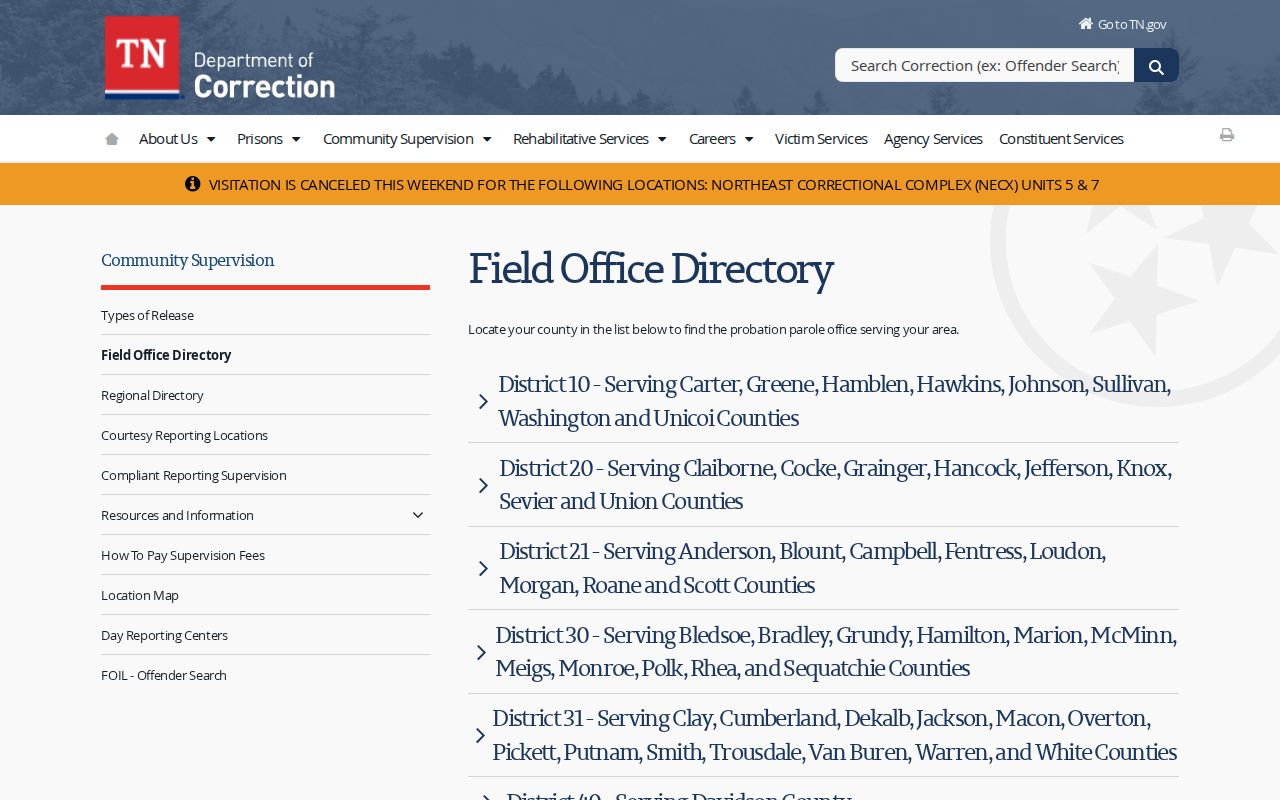
The image confirms the state supervision route near Coffee County without implying that every released local detainee is a TDOC case.
When calling either office, state the type of disposition and the public record already found. Ask whether that office is the correct administrative contact for the case. Do not ask staff to disclose a home address, reporting schedule, officer name, or private treatment detail. If the office is not responsible, return to the judgment and FOIL Assigned Location before trying another agency. This keeps the verification tied to the official disposition instead of a guess based on where the person was last held.
Coffee County Supervision Changes
Conditions are the rules attached to community supervision. Their exact terms come from the judgment, parole certificate, release plan, and supervising agency. A violation allegation may lead to a warrant, hearing, added terms, or return to custody, but it should not be described as a final result until the responsible authority acts. A warrant means an agency seeks the person. It does not prove that an arrest has occurred.
No official Coffee County absconder or warrant name search was verified. The Sheriff directory lists a Warrants and Sex Offender Registry function through the main number, 931-728-3591. The TBI Most Wanted list is statewide and is not a complete Coffee County warrant database. For interstate state supervision, FOIL Help points to the Interstate Compact public portal. A recent supervision change should be confirmed with the office responsible for the case, not inferred from silence in a public system.
Note: Tennessee VINE can report covered custody changes, but it is not a public list of probation violations or a certified supervision record.
Coffee County Parole Hearings
A parole hearing is part of the decision process, not proof of release. Tennessee Board of Parole hearing officers conduct proceedings at prisons, county jails, and other sites, then make recommendations. Board members make the final decision and may adopt, change, or reject a recommendation. Hearing types include grant, revocation, custodial, rescission, time-setting, and appeal matters. The Board hearing schedule page uses a request workflow rather than a stable statewide list. Schedules refresh weekly and may change. Requests go to BD.HearingSchedules@tn.gov, with confirmation at 615-741-1150.
FOIL can show a Parole Hearing Date and Parole Hearing Result for a specific offender. Those fields should be read with RED, current Supervision Status, and Assigned Location. TDOC calculates eligibility from the judgment and classification; the Board decides parole. Even a grant does not establish that physical release occurred because an approved release plan and other pre-release steps may remain.
The official parole-hearing process provides the decision context behind those person-level fields.
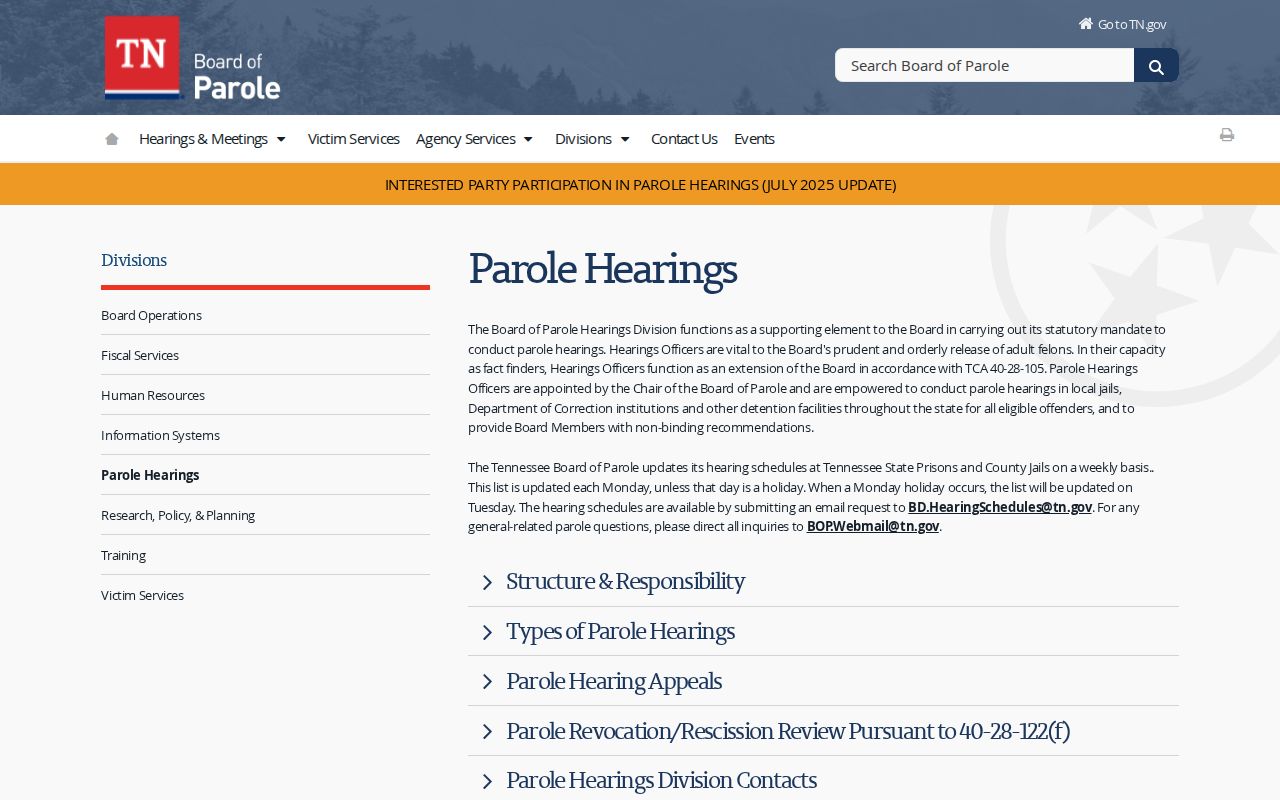
The source image supports the state decision route without turning a hearing, recommendation, or grant into a Coffee County jail release timestamp.
Coffee County Supervision Discharge
Supervision ends through a formal discharge, sentence expiration, court action, or other authorized disposition. Parole should not be described as a finished sentence merely because physical prison custody ended. FOIL's inactive status, read with no active Tennessee sentence and completed sentence data, supports the end of TDOC custody or supervision. It does not rule out a new local, federal, or out-of-state case.
For local probation, read the Coffee County court record and seek the order or case entry that ends the probation term. For state supervision, compare FOIL with TDOC records. Policy 511.03 identifies a Letter of Discharge for an expiration discharge and release paperwork that may note detainers or pending charges. Those records are stronger than a single current-status label when the exact legal end matters.
Coffee County Treatment Furloughs
Coffee County Recovery Court documents a local route that is neither ordinary release home nor parole. A qualifying post-plea participant may move directly from local jail into selected inpatient substance-use treatment after at least 90 consecutive days in local custody. The judge, District Attorney, defendant, and counsel must agree, and the participant must have a fully executed sentence of at least four years under the published program terms.
The Coffee County Recovery Court description excludes people on state or federal parole, federal supervised release, and people with pending charges outside Coffee County. That makes the disposition crucial. The movement is a court-authorized treatment furlough, not unrestricted release. The jail record and court order should identify the event, while Recovery Court supplies the local program context.
Note: A treatment furlough changes where a person is placed, but it should not be recast as parole or a completed sentence.
Coffee County Release ID Resource
A Coffee County Justice Center page describes a Tennessee safety kiosk that can pay driver-license reinstatement fees and renew or replace a driver license or photo ID. Valid identification can help a released person complete ordinary tasks and report to the correct office. Yet the county page also promotes a fair that has already passed, so continued kiosk operation should be checked before anyone relies on it.
The official Justice Center kiosk page is a useful lead, not a guarantee of present service. Call the Justice Center or the relevant state licensing service before travel. This resource does not verify parole, probation, or discharge status. Those answers remain with the court, FOIL, and the supervising office.