
Coffee County Release Date Types
“Projected release date” is not one official Coffee County field. For a pretrial detainee, release turns on bond, dismissal, a court order, or another case event. No sentence has yet produced a fixed completion date. For a locally sentenced person, the judgment, jail credit, release percentage, and any authorized credits shape the calculation. Coffee County does not publish an online calculator or roster field for that date.
For a TDOC felony offender, FOIL displays Release Eligibility Date and Sentence End Date. Release Eligibility Date, or RED, is when the governing sentence calculation permits parole consideration where allowed. It is not a promise that the person will leave custody. Sentence End Date is separate. Board action, release-plan approval, new court records, a detainer, or credit changes may still affect the outcome.
A detainer is a request or authority for another agency to take custody. If TDOC releases someone to a detainer, TDOC custody ends while confinement may continue elsewhere. The same caution applies when Coffee County transfers someone to TDOC, another county, federal custody, or immigration authorities.
Run a Coffee County Date Lookup
Start with the last known custodian. Coffee County Jail, a TDOC prison, and a federal facility use different records. The county's lack of an online roster or release feed makes direct jail and court checks important. FOIL should be used only when TDOC custody or supervision is involved. A person who bonded out on a local misdemeanor may never appear there.
- Call Coffee County Jail at 931-728-3591 to learn whether the person is physically held there and which disposition is recorded.
- Search both General Sessions and Circuit through the Coffee County court gateway. Read the judgment, bond order, sentencing order, and later case entries.
- For a local sentence, ask the jail or clerk for the calculation based on the judgment, jail credit, and court-set release percentage. Request the existing record rather than asking the county to create a forecast.
- For a state felony case, search TDOC FOIL by name, alias, TDOC ID, or SID. Match the birth date, identifiers, photograph, and descriptors.
- Read Supervision Status, Assigned Location, RED, Sentence End Date, active sentences, and parole fields together.
- Confirm an actual release through the final jail or TDOC paperwork and follow any named detainer or receiving agency.
The Coffee County release-record search gives the full custody-type fallback when the expected system has no match.
Coffee County Sentence Credit Rules
Tennessee sentence calculations begin with the judgment, offense date, offender range, sentence length, and whether terms run at the same time or one after another. Under Tenn. Code Ann. § 40-35-501, ordinary range release-eligibility percentages include 20 or 30 percent for an especially mitigated offender as stated in the judgment, 30 percent for Range I, 35 percent for Range II, 45 percent for Range III, and 60 percent for a career offender. These marks open parole consideration where permitted. They are not automatic exits.
Tenn. Code Ann. § 41-21-236 permits eligible inmates to earn from one through sixteen days of sentence credit per month served. Up to eight days may come from institutional conduct and up to eight from satisfactory program performance. TDOC awards credits under its rules, and credits may be lost or restored. The statute also reaches eligible felony offenders serving at least one year in a local jail or workhouse.
For a misdemeanor jail sentence, the court sets a release percentage from 30 through 100 percent in ten-point steps. Applicable credits cannot reduce that percentage by more than 25 percent. Coffee County has no published public calculator for this work. The individual judgment and jail calculation are required.
Note: Pre-sentence behavior credit may be recommended within the statutory limit, but the research does not support treating it as an automatic entitlement.
Coffee County Release Date Changes
FOIL warns that dates can change when new court documents arrive. That warning matters because sentence data does not stand still. An amended judgment can correct a term. A consecutive sentence can add an eligibility period. Earned credit may change. A parole hearing can result in denial or later review, while a grant still requires an approved release plan and other steps. County jail staff must also process a court order and check holds before physical release.
| Factor | Effect on the date or outcome |
|---|---|
| New or amended judgment | May change sentence length, credits, or concurrent and consecutive structure |
| Earned or lost credit | Can adjust an eligible calculation within state law |
| Discipline | May cause credit loss under applicable rules |
| Parole decision | May grant, deny, defer, or alter consideration; a grant is not the exit event |
| Release plan | Approval and placement steps may be needed before a parole release |
| Detainer or pending charge | May cause direct transfer to another authority instead of release home |
| Administrative recalculation | Can update RED or sentence end when TDOC receives more records |
The correct response to a changed field is to preserve the old and new check dates, identify the agency, and ask for the record behind the change. Do not convert a stale screenshot into a fixed promise.
For example, a RED next month does not answer whether a person leaves prison next month. Check for an active sentence, present location, parole hearing result, and sentence end. A denial, delayed hearing, incomplete plan, new judgment, or detainer may prevent that outcome. If FOIL later says parole, it supports community supervision but still does not supply the precise prison-exit time. That time belongs in the state release authorization.
Coffee County RED Is Not Release
Tennessee FOIL uses a precise forward-looking label: Release Eligibility Date. It presents Sentence End Date as a different field. RED answers when parole consideration can become available under the controlling calculation, while Sentence End Date addresses the term's end. Neither proves that release took place. For qualifying felony sentences of two years or more based on offenses committed on or after July 1, 2024, § 40-35-501(ff) says credits do not change expiration. They may reduce the percentage before parole eligibility. If release occurs on or after eligibility, the remaining term is served on parole.
Tennessee does not have one universal “serve 85 percent” rule. Specified offenses and offense dates have 85-percent eligibility provisions, with statutory floors and credit treatment. Other listed offenses require 100-percent service. Life sentences and offense-specific rules differ. The offense, offense date, range, sentence structure, jail credit, and earned or lost credits must be known before applying a percentage.
The official TDOC types of release page places those date fields in the wider context of parole, determinate release, and other authorized outcomes.
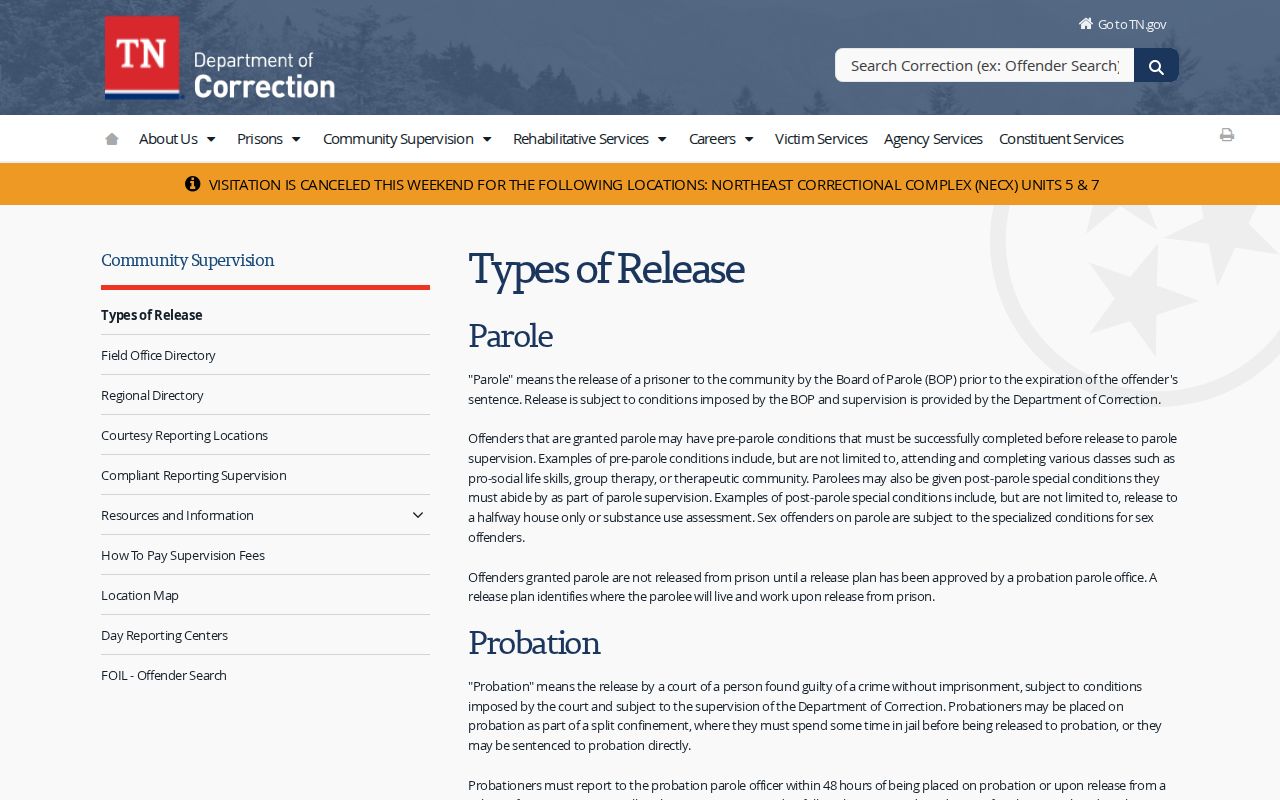
The captured source helps distinguish release mechanisms without turning an eligibility milestone into a confirmed exit date.
Coffee County Short Sentence Releases
TDOC describes determinate release for qualifying felony sentences of at least one year but no more than two years after at least 30 percent service. Determinate release is probation, not parole. Notice and objection procedures apply. That label should be kept intact when it appears in a Coffee County judgment or state record.
Mandatory reentry supervision adds another distinction. Under Tenn. Code Ann. § 40-35-506, an eligible person may spend the final part of a felony sentence in the community under supervision, or a supervision period may follow expiration under the statute. Physical prison release can therefore occur before supervision ends. A release date answers when confinement ended, not always when every legal duty ended.
Coffee County's posted work-release rules do not supply a sentence-release date. Work release permits approved movement for a work shift while custody continues and the person must return. The document is dated 2008, so its detailed timing should not be treated as current without confirmation. It also cannot be used as a countywide release schedule.
Coffee County Release Paperwork
TDOC Policy 511.03 shows why a final release record is more useful than a projected field. The institutional process uses Release Checklist CR-3835 and Offender Release Authorization CR-1947. An expiration discharge also produces Letter of Discharge CR-1945. The records can identify the release type, offender and TDOC number, institution, sentence and offense information, processing details, pending charges, and detainers.
Before expiration discharge, TDOC records staff review sentence-reduction credits, court papers, Board action, detainers, unentered sentences, and sentence calculations. Sentence Information Services authorizes expiration discharge. Planning reports can look forward, but those administrative tools are not substitutes for completed paperwork. A detainer field may show that the person left TDOC only to enter another agency's custody.
Coffee County does not publish an equivalent online field schema. For a local case, ask for the existing release sheet, jail card, court order, and any transfer entry. Request the date and time, release disposition, releasing facility, and destination or detaining agency. If no single “release report” exists, ask which existing record stores each fact.
Keep the paperwork tied to the same person and case. Compare the booking number, court number, TDOC or SID identifiers, facility, and offense data before joining records. Similar names can produce a false timeline. A complete chain shows the sentence source, the calculated milestone, the agency's final action, and any receiving custodian.
Confirm Coffee County Release Dates
Confirmation should follow the custodian. For Coffee County Jail, ask for the recorded release date and time, disposition, releasing facility, transfer destination, and court-order reference. A court order can explain why release was authorized, but the jail sheet records physical processing. For TDOC, current status and final release authorization are stronger than RED alone.
Tennessee VINE can send a pending custody-change alert for covered Coffee County and TDOC records. The Coffee County VINE inmate check explains the one-person search and registration process. Treat an alert as notice, then reconcile it with the jail, FOIL, or TDOC paperwork. VINE does not cover federal custody.
When a date affects a court filing or other formal process, request the originating record. Coffee County Sheriff supplies the local custody contact, and the county public-records process can be used for existing booking and release documents. TDOC Constituent Services accepts state record questions. Ask for records by name and approximate date. The county need not create a new forecast or combined report.
Note: A date becomes reliable when its label, custodian, sentence context, and final disposition all agree.